Specialist Orthodontics Licensing Exam | 2026 Updates
On 11 May 2026 | Read time about 6 Minutes
On This Page
Passing the Orthodontics Specialty Licensing Exam is a mandatory step before a foreign-trained orthodontic specialist can secure a license to work as a Specialist Orthodontist in the GCC (Gulf) countries. The specific exam you are required to take depends entirely on where you intend to work as provided in the below table.
This guide covers every exam in the Gulf region you need to know and their eligibility, requirements, exam format, topic weightage, syllabus, recommended references, and frequently asked questions, helping you plan your licensing journey with complete clarity
|
Exam
/ Authority |
Where
You Can Work |
Test
Provider |
|
DHA – Dubai Health Authority |
Dubai only |
Prometric |
|
DOH (formerly HAAD) |
Abu Dhabi & Al Ain, UAE |
PearsonVue |
|
SDLE / SCFHS |
Any city in Saudi Arabia |
Prometric |
|
QCHP / DHP MOPH Qatar |
Qatar |
Prometric |
|
NHRA |
Bahrain |
Prometric |
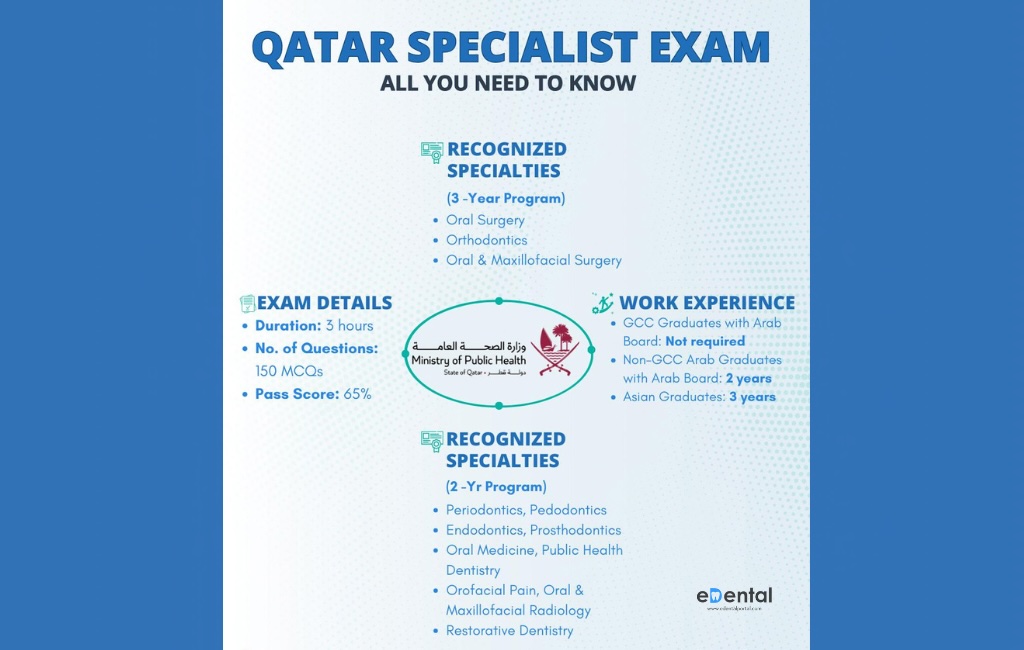
The DOH (Abu Dhabi) exam is delivered via Pearson Vue, while all other Gulf licensing exams for orthodontics are administered through Prometric test centers. Find further detailed information about Qatar Specialist Exams here.
Eligibility & Requirements
Exam / Authority | Qualification | Work |
DHA – Dubai Health Authority | Dubai only | 3 years after post graduation |
DOH (formerly HAAD) | Abu Dhabi & Al Ain, UAE | 3 years after post graduation |
SDLE / SCFHS | Any city in Saudi Arabia | 2 years after post graduation |
QCHP / DHP MOPH Qatar | Qatar | 2 or 3 years after post graduation (See below) |
NHRA | Bahrain | 3 years after post graduation |
1. Qualification:
You must hold a recognized postgraduate qualification in Orthodontics (such as an MDS, MSc, or equivalent specialty degree) from an accredited institution, along with the required post-qualification clinical experience as outlined below. If your degree is from Europe, please ensure that this is a clinical degree and not a research-based degree. Only full-time, clinical degrees are recognized in the Middle East. If you need specific guidance on your eligibility, you can contact our team on support@edentalportal.com
2. Work experience for Specialist Orthodontics exam:
For the DHA (Dubai), DOH/HAAD (Abu Dhabi), and QCHP (Qatar) exams, non-UAE and non-GCC nationals are required to have a minimum of three (3) years of post-specialist qualification experience. For SDLE (Saudi Arabia), two (2) years of post-qualification experience is required to be eligible at Registrar level.
What documents are typically required?
You will typically require:
- A valid specialty degree certificate.
- An Experience Letter or certificate.
- A good standing certificate from your current or most recent licensing authority (usually valid for no more than 6 months at time of submission)
- A valid professional license.
- Positive Primary Source Verification (Dataflow) report confirming your credentials
eDental Portal offers
full assistance with all the paper work involved in the
Licensing process. Simply complete the form here to find all the fees involved
& begin the journey.
Can I apply for multiple Gulf exams simultaneously?
Yes, you can apply for exams
in multiple countries simultaneously. However, each authority has its own
application portal, fees, and documentation requirements and each license
is valid only in that specific country or emirate.
Exam Format
What is the exam pattern/ format of the
Orthodontics Specialist exam?
All Orthodontics licensing
exams for working in any of the Gulf countries are computer-based tests
(CBT) in English language.
- Consists of long, clinical scenario-based multiple-choice
questions (MCQs) with 4 options. Two of the options are usually very
closely correct, but a single best answer to be chosen to score a
mark.
- There is no negative marking for incorrect answers.
- The exams assess both theoretical knowledge and clinical decision-making
ability.
- The tests are taken at 120 test-centres, located
across the world throughout the year.
How many questions are in the Specialist Orthodontics GCC licensing exam, and how long do I have?
|
Exam |
Questions |
Duration |
Pass Mark |
|
DHA Dubai |
150 MCQs |
2 hours, 50 Minutes |
60% |
|
DOH/HAAD Abu Dhabi |
100 MCQs |
120 minutes |
65% |
|
SDLE Saudi Arabia |
200 MCQs |
4 hours |
65 and 70% |
|
QCHP Qatar |
150 MCQs |
3.5 hours |
65% |
|
NHRA Bahrain |
150 MCQs |
3 hours |
60% |
- The total number of questions for the DHA exam is 150 MCQs to be answered over 2 hours and 45 minutes on a computer.
- For the DOH (HAAD) Abu Dhabi exams, the test consists of 100 multiple-choice questions, completed on a computer within 2 hours.
- For Specialist Orthodontics Saudi exams, the exam is divided into two separate papers, each comprising 100 multiple-choice questions and lasting 2 hours.
What is the Orthodontics prometric exam passing score?
The passing score varies depending on the health authority.
- For the DHA (Dubai) exam, the pass mark is 60%.
- For DOH/HAAD, Qatar and NHRA Bahrain, the pass score is 65%
- In Saudi Arabia under SDLE/SCFHS, the required score is 65% for Registrar level and 70% for Senior Registrar level.
How many attempts of Specialist Orthodontics Licensing
Exams are allowed?
- For DHA, DOH & MOH: 3 total attempts across DHA, DOH and MOH. You may reapply 3 new attempts on gaining additional qualification or after gaining at least 2 years of clinical experience following the last exam attempt for the same title.
- For QCHP Qatar, candidates may sit the exam up to three times within a single calendar year, with a maximum of three attempts allowed within a three-year window from the first attempt.
- For NHRA Bahrain - You are allowed to appear for the Bahrain Specialist Licensure examination, four times provided that the attempts are done within a maximum of three years from the first attempt.
What is the Exam Fees for Orthodontics Specialist Exams?
Exam / Authority | Exam Fees | Number of exam attempts allowed |
DHA – Dubai Health Authority | USD 280 (International) USD 336 (Indians Test Centers) | 3 total attempts across DHA, DOH and MOH* |
DOH (formerly HAAD) | AED 450 | 3 total attempts across DHA, DOH and MOH* |
SDLE / SCFHS | USD 289 | 4 |
QCHP / DHP MOPH Qatar | USD 280 | 3 attempts within 3 years' time (See below) |
NHRA | USD 280 | 3 |
What type of questions should I expect
in Specialist Orthodontics Licensing Exams?
Questions are clinical scenario-based and
evidence-driven. Rather than testing rote memorisation, the exam evaluates your
clinical judgment, diagnostic reasoning, treatment planning, and knowledge of
current Orthodontics literature. Expect questions that require you to apply
your specialist training to real-world patient scenarios.
Syllabus & Topic Weightage
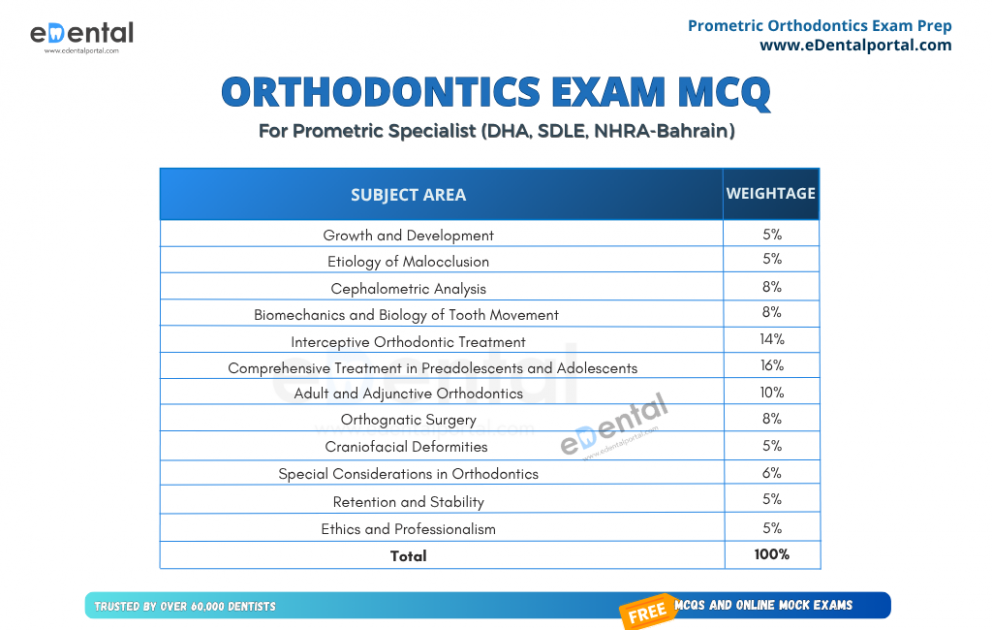
The Orthodontics Gulf prometric exam is
designed to assess specialist-level competence across a broad range of clinical
and academic areas. Below is the official topic weightage:
|
Subject
area |
Weightage |
|
Growth & Development |
5% |
|
Etiology of Malocclusions |
5% |
|
Cephalometric Analysis |
8% |
|
Biomechanics and Biology of Tooth Movement |
8% |
|
Interceptive Orthodontic Treatment |
14% |
|
Comprehensive Treatment in Preadolescents and
Adolescents |
16% |
|
Adult and Adjunctive Orthodontics |
10% |
|
Orthognathic Surgery |
8% |
|
Craniofacial Deformities |
5% |
|
Special Considerations in Orthodontics |
6% |
|
Retention and Stability |
5% |
|
Ethics and Professionalism |
5% |
|
Patient Safety |
5% |
|
Total |
100% |
Which textbooks are recommended by the Official Bodies for Exam Preparation?
The following references are highly recommended and align with the exam syllabus:
·
An Introduction to Orthodontics by Laura Mitchel
·
Contemporary Orthodontics by William R. Proffit
·
The Biomechanical Foundation of Clinical Orthodontics
by Charles J. Burstone, Kwangchul Choy
·
Biomechanics and Esthetic Strategies in Clinical
Orthodontics by Ravindra Nanda
·
Mosby's Orthodontic Review
·
Orthodontics: Current Principles and Techniques
authored by Lee W. Graber, Katherine W. L. Vig, Greg J. Huang, and Pádhraig S.
Fleming, 7th edition (2023)
·
These books are nearly impossible to get
through efficiently. eDental Portal cuts through the noise with
Orthodontics prometric MCQ questions as a high yield Question Bank, delivering
only the high-yield concepts that actually show up in exams.
How should I structure my preparation?
A structured 1.5 month preparation plan
is generally recommended for candidates with active
clinical practice who are using eDental Portal. Start with
high-yield topics with highest weightage, then systematically
work through the remaining topics. Practicing timed
mock tests under exam conditions, particularly for the Saudi exam with its
4-hour format is essential for building both knowledge and stamina.
Whether you are preparing for the DHA, SDLE, DOH/HAAD, QCHP, or NHRA Orthodontics specialist exam, your success begins with a strong clinical foundation and a structured study plan.
Simple Step-by-Step Flow to work as an Orthodontist in the Gulf
- Choose your target country
- Apply to the official authority (e.g. DHA / DOH / DHP / SCFHS) Or use eDental Portal's registration assistance service
- Complete DataFlow verification. End to end service for this is also provide by eDental Portal, if needed.
- Get eligibility approval
- Book/Schedule your Licensing exam
- Prepare for Licensing Exams using eDental Portal
All steps highlighted in blue above can be seamlessly facilitated through the eDental Portal: a trusted source for complete exam assistance with over 10 years of exclusive expertise in the dental profession.
On This Page
Latest Posts



FREE PROMETRIC PRACTICE TESTS
Try out the most relevant Prometric mock test questions for Dental exams here.
ENROLL NOW




 عربي
عربي 